



Eco-Friendly Garden Annexes: Green in Name, Green in Nature
When choosing a garden annexe, most people ask the obvious questions: How big will it be? How much will it cost? And how quickly can it be built?
However, the materials and construction methods behind eco-friendly garden annexes are just as important when considering energy efficiency, durability and environmental impact.
Fewer people ask what goes into the building itself, or how the materials and construction methods might affect their garden and the wider environment.
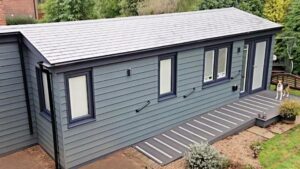 At The Green Room, we consider those questions from the very beginning. From the foundations that support the structure to the highly insulated SIPs and long-lasting roof coverings, we choose materials and construction methods that combine performance, durability and lower environmental impact.
So, what makes a Green Room annexe a greener way to build? Here’s the eco story behind it.
A finished Green Room annexe, settled naturally into its garden.
At a Glance
| Feature | Environmental Benefit |
|---|---|
| Screw pile foundations | Reduce the need for concrete and extensive excavation, helping to lower environmental impact while causing considerably less disruption to the garden. |
| SIPs (Structural Insulated Panels) | Provide excellent thermal performance, helping to reduce the energy needed to keep your annexe comfortable throughout the year. |
| EPDM roofing | Offers a life expectancy of more than 50 years when correctly installed and maintained, reducing the need for frequent roof replacement. |
| TapcoSlate | Creates the appearance of traditional slate without using quarried natural slate. It is lightweight, durable and recyclable at the end of its service life. |
| Sedum living roofs | Help manage rainwater, support biodiversity and add valuable greenery back into the garden. |
Screw Pile Foundations: A Lower-Impact Alternative to Concrete
Traditional extensions often rely on excavated concrete foundations. This usually involves digging trenches, removing soil, bringing concrete onto the site and allowing time for it to cure before construction can continue.
While concrete remains an important construction material, its environmental impact is significant. Cement production alone accounts for an estimated proportion of global CO₂ emissions.
For this reason, we use screw pile foundations wherever ground conditions and the individual project allow.
Rather than excavating large areas of the garden and pouring substantial concrete foundations, contractors screw steel piles directly into the ground. This creates considerably less mess and allows construction to progress without waiting for concrete to cure.
Because screw piles displace relatively little soil, they can also help minimise disruption to lawns, surrounding planting and the wider garden.
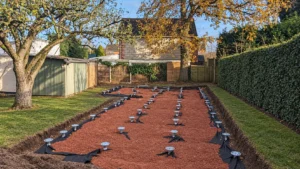
Screw piles installed on one of our projects, ready to support the insulated SIPs floor.
No Curing Time, Less Disruption
Once the screw piles are installed and correctly positioned, we can begin constructing the insulated floor system above them. There is no need to wait several days for concrete foundations to cure.
Raising the annexe slightly above ground level also creates ventilation beneath the structure and keeps the structural floor away from direct contact with the soil.
Steel offers another useful advantage: it is recyclable. Unlike a permanent concrete foundation, contractors can remove screw piles if the annexe ever needs to be repositioned or taken away. Depending on their condition and the requirements of a future installation, they may also be suitable for reuse.
Therefore, screw piles provide more than a strong foundation. They can reduce excavation, minimise disruption to the garden and reduce the amount of concrete required for the project.
SIPs: High Performance Built Into the Structure
Above the foundations, Structural Insulated Panels (SIPs) form the insulated structural core of our garden annexes.
We use SIPs throughout the building to create a highly insulated envelope. Their excellent thermal performance helps retain warmth during colder weather and reduces unwanted heat transfer through the structure.
As a result, the annexe requires less energy to maintain a comfortable indoor temperature throughout the year.
Our SIPs construction can achieve U-values as low as 0.108 W/m²K, depending on the building element and specification.
Because manufacturers produce SIPs accurately in controlled factory conditions before they arrive on site, the system can also reduce on-site cutting and construction waste while helping us get the structure weathertight quickly.
Want to understand the figures? Read our guide to garden annexe U-values and insulation.
Sustainable Roofing Designed for the Long Term
The environmental impact of a roof isn't only about the material used to make it. How long that material lasts also matters.
A durable roof covering reduces the need to manufacture, transport, remove and dispose of replacement materials during the lifetime of the annexe.
Depending on the design of your garden annexe, we offer several roofing options.
EPDM Flat Roofing
For our flat-roof garden annexes, we use a durable EPDM synthetic rubber roofing membrane.
When correctly specified, installed and maintained, EPDM roofing can have a life expectancy of more than 50 years. Its long service life reduces the need for frequent roof replacement and the associated use of additional materials.
EPDM also provides a seamless, low-maintenance waterproof covering, making it particularly suitable for contemporary flat-roof garden annexes.
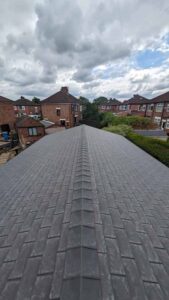
TapcoSlate Pitched Roofing
For customers who prefer a more traditional pitched roof, we offer TapcoSlate synthetic slate.
TapcoSlate provides the appearance of natural slate without using quarried natural slate. Its lightweight construction also reduces the load placed on the roof structure and makes the material easier to transport and handle.
The manufacturer states that TapcoSlate is recyclable at the end of its service life and provides a 40-year manufacturer's warranty.
TapcoSlate fitted to a Green Room garden annexe.
Sedum Living Roofs: Putting Greenery Back
For customers who want to take the environmental credentials of their garden annexe a step further, we can also offer a sedum living roof.
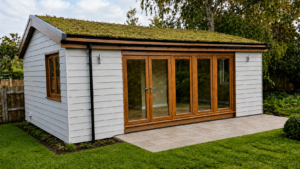 Instead of leaving the roof as an unused surface, a sedum system introduces a layer of hardy, low-growing plants above the waterproof roof covering.
A Green Room annexe finished with a sedum living roof.
A sedum roof offers several environmental benefits.
| Benefit | How a Sedum Roof Helps |
|---|---|
| Rainwater management | The plants and growing medium retain some rainfall and release it more gradually, helping to slow rainwater run-off. |
| Reduced summer heat gain | Vegetation shades the roof surface and can help reduce solar heat gain during warmer weather. |
| Biodiversity | Sedum creates habitat and a food source for insects and pollinators. |
| More greenery | Although it cannot completely replace the garden area occupied by the annexe, it returns valuable vegetation to an otherwise unused roof surface. |
A living roof therefore does something conventional roofing cannot: it allows the roof itself to contribute to the garden around it.
Building with the Future in Mind
Sustainability isn't about choosing one particular product or material. We consider how each part of the annexe will perform throughout its lifetime.
From foundations that minimise excavation to highly insulated SIPs, durable roofing materials and optional living roofs, each decision plays a part.
Durability is particularly important. Materials that perform well for many years can reduce the need for replacement, while high levels of insulation can reduce the energy required to maintain a comfortable indoor environment.
At The Green Room, we design our garden annexes for comfortable, long-term, year-round use, rather than as temporary garden buildings.
Green in Name, Green in Nature
None of these choices happens by accident.
From screw pile foundations and highly insulated SIPs construction to long-lasting roofing materials and optional sedum roofs, we consider how each element contributes to the performance and longevity of the finished garden annexe.
Of course, no new building comes without an environmental footprint. However, thoughtful material choices, high levels of insulation and durable construction can help reduce that impact over the building's lifetime.
Just as importantly, high levels of insulation can reduce the amount of energy needed to heat the annexe, while construction methods that minimise excavation can help reduce disruption to the surrounding garden.
Together, these choices create a garden annexe that doesn't just look at home in its surroundings — we design and build it with those surroundings in mind.
That's why Green in Name, Green in Nature means more to us than a slogan. It reflects the way we approach every Green Room annexe.
Considering a garden annexe? Get in touch with The Green Room for a free, no-obligation quote.
Back to Blog