



A Guide to the Caravan Act and Granny Annexes
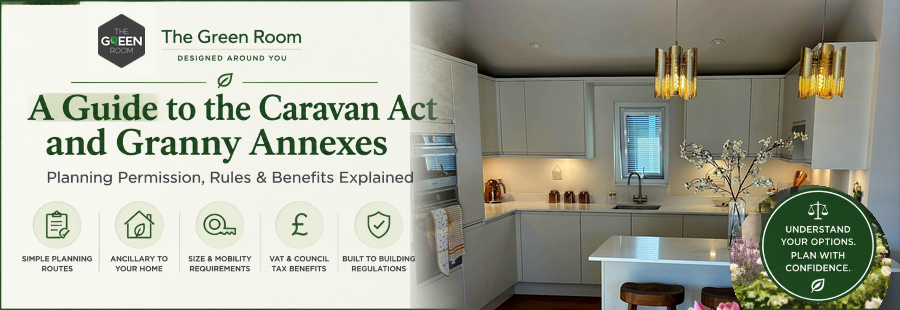
The Caravan Act can allow you to site a qualifying granny annexe within the garden of a main house without full planning permission. To qualify, the annexe must meet specific size, construction and transportability criteria. Its location and use also matter, and the annexe must remain ancillary to the main dwelling.
Not every granny annexe qualifies for this route. Its size, construction, location and proposed use all help determine whether the Caravan Act applies. If the annexe falls outside the required criteria, you may need to apply for full planning permission instead. Although full planning offers greater design flexibility, it usually costs more and takes longer to secure.
This guide explains how the Caravan Act applies to granny annexes, the criteria an annexe needs to meet, how this route compares with full planning permission, and which option may best suit your project.
What You Need to Know
Understanding the Caravan Act requirements can help you establish whether your proposed granny annexe may follow a simpler planning route or whether full planning permission is likely to be required. The key points to consider are summarised below.Key Takeaways
At a Glance
- A Caravan Act-compliant granny annexe can often follow a simpler planning route than a permanent building.
- To qualify, the annexe must meet specific size and transportability requirements set out in the Caravan Sites Act 1968.
- Many homeowners apply for a Certificate of Lawful Development instead of full planning permission.
- A Caravan Act granny annexe must remain ancillary to the main house and cannot be used as an independent dwelling.
- Some Caravan Act-compliant annexes may qualify for VAT relief and Council Tax reductions, depending on individual circumstances.
- Always choose a manufacturer that builds to Building Regulations standards as well as meeting the Caravan Act requirements.
Contents
- What Is the Caravan Act for Granny Annexes?
- Do Caravan Act Annexes Need to Meet Building Regulations?
- How Does the Caravan Act Apply to Granny Annexes?
- Caravan Act Size Limits
- Does a Granny Annexe Need to Be Moveable?
- Other Caravan Act Requirements
- Benefits of a Caravan Act-Compliant Annexe
- Do I Need a Certificate of Lawfulness?
- Caravan Act vs Full Planning Permission
- Frequently Asked Questions
What Is the Caravan Act for Granny Annexes?
The Caravan Sites and Control of Development Act 1960, together with the Caravan Sites Act 1968, sets out the legal definition of a caravan or mobile home.
Under Section 13 of the Act, a caravan must:
- be designed for human habitation
- be capable of transport by road
This legal definition forms the basis of whether a granny annexe, garden annexe, or garden lodge can qualify as a caravan for planning purposes.
Do Caravan Act Granny Annexes Need to Meet Building Regulations?
Although the Caravan Act may classify a granny annexe as a caravan for planning purposes, many manufacturers choose to build their annexes to standards that meet or exceed Building Regulations requirements. However, not all manufacturers follow the same specification, so always check exactly what the quotation includes before making your decision.
A granny annexe built to Building Regulations standards typically offers high levels of insulation, structural strength, fire safety, sound insulation and energy efficiency. Choosing a manufacturer that combines Caravan Act compliance with high construction standards can help provide a safe, comfortable, energy-efficient and long-lasting home.
Expert Tip
Don't assume every manufacturer builds to Building Regulations standards simply because their annexe complies with the Caravan Act. Before comparing quotations, ask whether the price includes Building Regulations compliance, structural calculations, high-performance insulation, fire safety measures, and all the documentation needed to demonstrate Caravan Act compliance.How Does the Caravan Act Apply to Granny Annexes?
A granny annexe can qualify as a mobile home under the Caravan Act if it meets the following requirements.
What Are the Caravan Act Size Limits for a Granny Annexe?
To qualify as a twin-unit caravan, the assembled structure must not exceed 20 metres in length, 6.8 metres in width and 3.05 metres in internal height, measured from the floor at the lowest level to the ceiling at the highest level.The structure must not exceed:
- Length: 20 metres (65 feet)
- Width: 6.8 metres (22 feet)
- Height: 3.05 metres (10 feet), measured internally from floor to ceiling
Does a Granny Annexe Need to Be Moveable?
Although a granny annexe does not need wheels, it must be capable of being transported by road.
Manufacturers can meet this requirement by considering transportability from the outset. Where site access is restricted, they can manufacture the garden annexe as two separate sections and transport them in kit form to the property for installation.
During installation, the two sections remain separate while the installers complete the internal and external finishes. This includes fitting the windows, doors, electrics, plumbing, kitchen, bathroom, built-in furniture, fixtures and fittings. Throughout this stage, a clear gap remains between the two sections.
At the final stage, the installers join the two sections together to create a single, habitable granny annexe. Structural calculations and a lifting plan can then help demonstrate that the completed annexe remains capable of transportation.
What Other Requirements Must a Caravan Act Annexe Meet?
Meeting the legal definition of a caravan is only part of the planning consideration. The granny annexe must also remain ancillary to the main house and should not function as a separate, independent dwelling. Its location, access, occupation and relationship with the main property can therefore affect the planning position.
Features that suggest the annexe could operate independently may raise concerns with the local planning authority. These could include a separate address, independent access or living arrangements that make the annexe appear separate from the main house.
What Are the Benefits of a Caravan Act-Compliant Granny Annexe?
If your granny annexe meets the requirements of the Caravan Act, you could benefit from a simpler approval process and potential cost savings.
1. A Simpler Planning Route
In many cases, a Caravan Act-compliant granny annexe does not require full planning permission. Instead, homeowners can often apply for a Certificate of Lawful Development, providing the annexe complies with the relevant legislation and your local planning authority's requirements. This route is typically quicker, less complex, and more straightforward than submitting a full planning application.
2. Potential Council Tax Savings
Depending on how the annexe is used and who lives in it, you may be eligible for a Council Tax exemption or reduction. For example, an annexe occupied by an elderly or dependent relative may qualify for relief, subject to your local authority's criteria.
3. Possible VAT Relief
Qualifying granny annexes and garden annexes may be eligible for VAT relief, helping to reduce the overall cost of your granny annexe project. The amount of VAT payable depends on the type of annexe and how it will be used, so it's always worth confirming your eligibility before work begins.Do I Need a Certificate of Lawfulness for a Granny Annexe?
A Certificate of Lawfulness is not always compulsory, but it can provide formal confirmation from your local planning authority that the proposed use and siting of your granny annexe is lawful.
Before construction begins, it's important to choose the most suitable route for your project. Whether your granny annexe qualifies under the Caravan Act or requires full planning permission will determine the approvals and documentation your local authority requires.
In many cases, you can apply for a Certificate of Lawfulness. Although not compulsory, it provides formal confirmation and peace of mind that your annexe complies with planning legislation without the need for full planning permission. It is recommended that a certificate of lawfulness is obtained before any work is commenced.
Finally, each local planning authority can interpret planning policy and permitted development rights slightly differently. As a result, the requirements for a garden annexe or granny annexe can vary depending on where you live.
Caravan Act vs Full Planning Permission for Granny Annexes
| Caravan Act Route | Full Planning Permission |
|---|---|
| Simpler planning route in many cases | Full planning application required |
| Certificate of Lawful Development often recommended | Planning approval required before work begins |
| Must meet Caravan Act size limits | Greater design flexibility |
| Must remain ancillary to the main house | May allow different forms of occupation (subject to planning approval) |
| Can often be manufactured in two sections | Construction method varies |
| May qualify for VAT relief | VAT treatment depends on the project |
| Usually faster to progress | Planning process can take longer |
Additional Tips
- Consult your local planning authority early in the planning process.
- Choose a supplier with experience designing and installing Caravan Act-compliant granny annexes.
- Confirm that your proposed garden annexe meets the relevant Caravan Act criteria before submitting any application.
- Obtain all necessary planning approvals and legal documentation before construction begins.
- Ask your supplier to provide structural calculations and lifting plans where required to demonstrate compliance with the Caravan Act.
- Compare granny annexe quotes
Frequently Asked Questions About the Caravan Act and Granny Annexes
Does a granny annexe built under the Caravan Act need planning permission?
Not always. If your granny annexe meets the size and mobility requirements set out in the Caravan Act, you may not need full planning permission. However, every local planning authority assesses proposals individually, so you should always confirm the requirements before construction begins.
Can a granny annexe on a concrete foundation qualify under the Caravan Act?
Not necessarily. A granny annexe can sit on a concrete base or slab, provided it remains capable of being moved and continues to satisfy the legal definition of a caravan under the Caravan Act. However, permanently fixing the structure to the ground will affect its status, so seek professional advice before proceeding.
Does the annexe need wheels to qualify under the Caravan Act?
No. A granny annexe does not need wheels. However, it must remain capable of being transported by road. Manufacturers typically demonstrate this by providing structural calculations and a lifting plan to show the building can be safely moved by crane.
Can a large granny annexe still qualify if access to the garden is limited?
Yes. Manufacturers can build a larger garden annexe in two separate sections, transport each section to your property, and complete the final assembly on site. This approach allows larger annexes to comply with the Caravan Act while overcoming restricted access.
Are there tax benefits to building under the Caravan Act?
Potentially. A Caravan Act-compliant granny annexe may qualify for VAT relief, reducing the overall project cost. Depending on who occupies the annexe and how they use it, you may also qualify for a Council Tax exemption or reduction.
Can a granny annexe be used as an independent dwelling or sold separately?
No. A granny annexe approved under the Caravan Act must remain ancillary to the main house. It should not have its own separate access or function as an independent dwelling. Local planning authorities may also object if the annexe appears capable of being sold separately from the main property.
What is a Certificate of Lawfulness, and do I need one?
A Certificate of Lawfulness is a formal decision issued by your local planning authority confirming that your proposed or existing development is lawful. Although you do not always need one, it provides valuable legal certainty and is often recommended where a granny annexe proceeds without full planning permission.
Do the rules under the Caravan Act vary between local authorities?
Yes. Although the Caravan Act applies nationally, local planning authorities may assess how the legislation applies to individual projects differently. As a result, the evidence and information required can vary from one council to another. Always check with your local authority before starting your granny annexe project.
How much does a Caravan Act granny annexe cost?
The cost depends on the size, layout, specification, site conditions and utility connections. For current guide prices and details of what's included, see our garden annexe pricing guide.
Can The Green Room handle the Certificate of Lawfulness application?
Yes. We can manage the Lawful Development Certificate (LDC) application on your behalf, including preparing and submitting the relevant paperwork to your local planning authority. Find out more about planning permission for granny annexes.How long does a Caravan Act granny annexe take to install?
Most granny annexes take around 4 to 6 weeks to install on site, depending on their size and design. This includes the foundations, construction, utility connections and internal fit-out. See our process to learn more about how we design and install your granny annexe.
Conclusion
Whether your project qualifies under the Caravan Act or requires full planning permission, understanding the correct planning route from the outset can save both time and money. If you're considering a granny annexe, seek professional advice before work begins to ensure your project complies with the relevant legislation and local planning requirements.
Not Sure if Your Granny Annexe Qualifies Under the Caravan Act?
We can assess your proposed annexe, discuss whether the Caravan Act or full planning permission is likely to provide the most suitable route, and explain the next steps. During our free site survey, we can also assess access, ground conditions and utility connections before preparing your bespoke design and fixed-price quotation.
Request a Free Site Survey Return to our Home Page Back to Blog